

International Grocery Hotspots in Jakarta
International Grocery Hotspots in Jakarta: Which Neighborhoods Offer the Best Selection for Expats
For expatriates settling into Jakarta, daily comfort rarely comes from headline attractions. It comes from routines. Where you buy bread, cheese, olive oil, or miso paste often determines how quickly the city starts to feel livable. In relocation surveys across Asia, access to familiar groceries consistently ranks among the top lifestyle concerns for long-term expats, often ahead of entertainment or nightlife.
Jakarta’s international grocery landscape is deeply shaped by urban form. Imported supermarkets do not spread evenly across the city. They cluster where embassies, international schools, premium apartments, and long-stay expat housing intersect. As a result, grocery access becomes a reliable indicator of which neighborhoods are truly expat-ready, and which are merely well-located on a map.
This article looks at Jakarta’s most reliable international grocery hotspots, from established South Jakarta enclaves to newer satellite cities like BSD City and Alam Sutera, where planned development has created strong alternatives to the inner city.
Why International Grocery Access Shapes Expat Livability
For short stays, Jakarta’s local food scene is more than sufficient. For longer assignments, the equation changes. Families need consistent access to imported dairy, specific cooking ingredients, and dietary products that local minimarkets do not stock reliably. Professionals working long hours value supermarkets that fit into predictable weekly routines.
From an urban planning standpoint, international grocery stores tend to follow stability rather than hype. They appear in neighborhoods where residents stay longer, spend consistently, and shape demand for quality retail. This is why international supermarkets often sit close to embassies, premium residential clusters, and mixed-use developments rather than purely commercial districts.
In Jakarta, grocery access is not a luxury. It is infrastructure.
South Jakarta: The Core of Jakarta’s Expat Grocery Ecosystem
Kemang, Jakarta’s Longstanding Expat Neighborhood
Kemang remains one of Jakarta’s most established expat areas, not because it is the most polished, but because it has evolved organically around foreign residents for decades. Its grocery scene reflects that long-term demand.
Grand Lucky Superstore Kemang, located on Jalan Kemang Raya, is one of the city’s most comprehensive international supermarkets. It carries European cheeses, Australian meats, American pantry staples, imported wines, and a broad range of frozen and specialty products. Price ranges are firmly premium. Imported cheese typically falls between IDR 120,000 and 350,000, cereals and packaged goods around IDR 80,000 to 200,000, and imported meats from IDR 150,000 upward.
Kemang is also home to Kem Chicks Kemang, a smaller but well-known premium grocer with a loyal following. While its selection is more curated than Grand Lucky’s, it remains popular for fresh produce, bakery items, and ready-to-eat options, with most imported products ranging between IDR 70,000 and 250,000.
What makes Kemang distinct is density. Multiple international grocery options sit within a relatively compact area, reducing reliance on long drives. From a lifestyle perspective, this favors families and long-term expats who value neighborhood familiarity over sleek new developments.
SCBD and Senopati, Premium Grocery Access in the Urban Core
SCBD and Senopati serve a different expat profile. These areas cater to professionals who prioritize proximity to offices, high-end apartments, and integrated urban amenities.
At District 8 SCBD, Grand Lucky SCBD functions as a key anchor tenant. The store offers a broad international selection similar in quality to its Kemang counterpart, but with a slightly more compact layout tailored to urban shoppers. Imported goods typically range from IDR 90,000 to 300,000, depending on category. Its placement within a mixed-use complex makes it particularly attractive to residents of nearby luxury apartments.
In Senopati, The Gourmet by Ranch Market has established itself as a premium destination for health-focused and imported products. The emphasis here is on organic produce, specialty pantry items, and ready-to-cook meals rather than bulk shopping. Prices reflect the positioning, with organic vegetables often priced between IDR 40,000 and 90,000 per item and imported prepared foods between IDR 90,000 and 200,000.
This part of South Jakarta benefits from careful urban integration. Grocery access is embedded within walkable, mixed-use environments, a feature still relatively rare in Jakarta.
Central Jakarta: Embassy Zones and Established Residential Areas
Central Jakarta does not offer the same density of international grocery stores as South Jakarta, but it remains relevant for diplomats and professionals working near government and embassy districts.
Grand Lucky Menteng, located in the Menteng area, serves this niche well. The store stocks a reliable selection of imported dairy, pantry items, frozen foods, and wines. Price ranges are consistent with other Grand Lucky branches, typically IDR 70,000 to 300,000 depending on the product.
Menteng’s appeal lies less in variety and more in stability. The surrounding neighborhood is quieter, greener, and oriented toward long-term residence. For expats attached to embassies or central offices, this trade-off often makes sense.
Read also: What Expats Miss From Home: Jakarta Grocery Guide
Pasar Santa: A Different Kind of International Grocery Experience
Not all international food shopping in Jakarta happens in polished supermarkets. Pasar Santa, located in South Jakarta near Blok M, represents a more informal but increasingly influential alternative.
Originally a traditional market, Pasar Santa has evolved into a hybrid space where local vendors coexist with specialty stalls offering imported cheeses, cured meats, artisanal bread, sauces, and international snacks. Prices vary by vendor, but imported cheeses typically range from IDR 90,000 to 250,000, while specialty condiments are often more competitively priced than in large supermarkets.
Pasar Santa appeals to expats who enjoy cooking, experimentation, and neighborhood texture. From an urban perspective, it reflects Jakarta’s capacity for adaptive reuse, where older market infrastructure becomes a lifestyle destination without losing its local character.
BSD City: Planned Urban Living with Strong Grocery Infrastructure
Southwest of Jakarta, BSD City has emerged as one of the most successful examples of master-planned urban development in Greater Jakarta. Its appeal to expats lies in space, organization, and consistency.
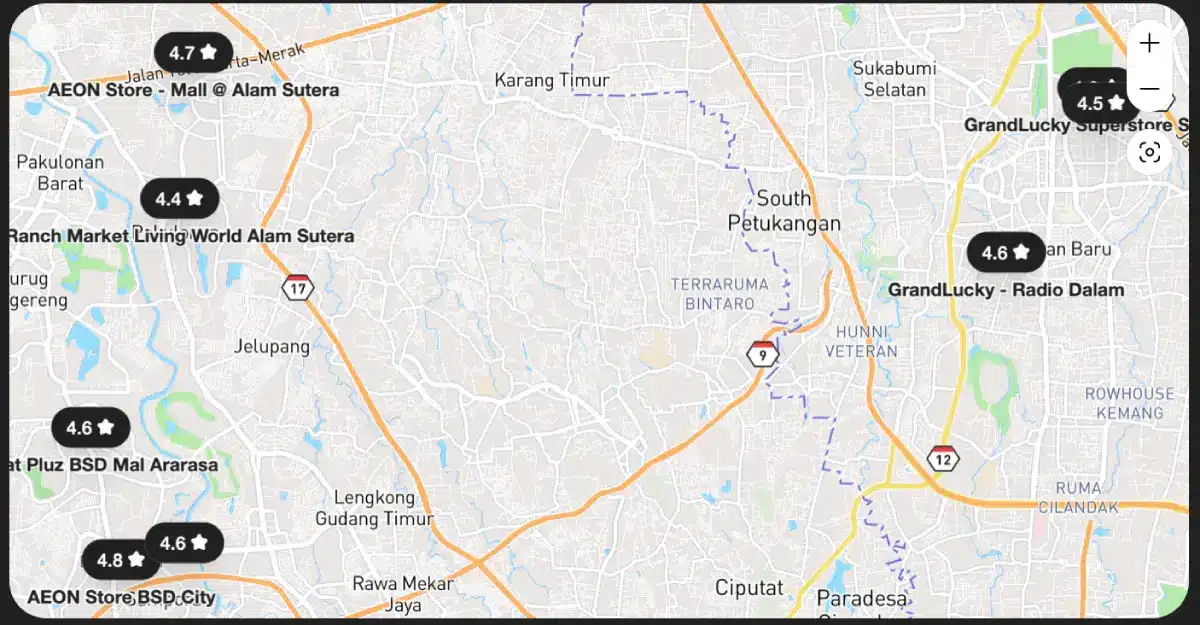
Ranch Market BSD, located at The Breeze BSD City, offers a full-scale international grocery experience comparable to South Jakarta branches. Imported products typically range from IDR 80,000 to 280,000. The store’s layout, parking, and family-friendly design reflect BSD’s planning priorities.
AEON Store BSD City, within AEON Mall BSD, adds a strong Japanese retail presence. Its supermarket section is particularly known for Japanese packaged foods, sauces, snacks, and fresh items. Prices are relatively competitive for imports, with many products falling between IDR 60,000 and 200,000.
For expat families, BSD City’s grocery ecosystem works in tandem with international schools, healthcare facilities, and low-density housing, creating a self-contained lifestyle that reduces dependence on central Jakarta.
Alam Sutera: Compact, Accessible, and Strongly International
Alam Sutera offers a more compact alternative to BSD City while maintaining a high standard of international retail. Its development pattern emphasizes accessibility and integrated commercial zones.
Ranch Market Living World Alam Sutera anchors the area’s international grocery offering. The store carries a wide selection of Western and imported goods, with price ranges similar to other Ranch Market branches, generally IDR 80,000 to 300,000.
Nearby, AEON Store Alam Sutera provides additional depth, particularly for Japanese products and ready-to-eat meals. Together, these supermarkets create a grocery environment that comfortably supports long-term expat living.
Alam Sutera appeals to professionals working in western Jakarta or Tangerang who still want international standards without committing to larger townships.
Choosing a Neighborhood Based on Grocery Needs
In Jakarta, choosing where to live often starts with commute time, but grocery access deserves equal weight. Families who cook regularly may prefer Kemang, BSD City, or Alam Sutera. Professionals with demanding schedules may find SCBD or Senopati more practical. Those seeking character and flexibility may gravitate toward areas like Pasar Santa.
Budget considerations also matter. While imported groceries remain premium across the board, larger supermarkets in planned developments often offer better value for certain categories.
Read also: Convenience at Your Doorstep: Retail, Supermarkets & Dining in Apartments
Grocery Access as a Marker of Urban Maturity
International grocery availability is one of the clearest signals of urban maturity in Jakarta. It reflects not just consumer demand, but planning decisions, residential stability, and the city’s ability to support diverse lifestyles.
For expats evaluating Jakarta, grocery hotspots provide a grounded, everyday lens on livability. They show where daily routines are easiest to sustain, and where the city quietly works in your favor rather than against you.
Image by Freepik